

Views: 0 Author: Site Editor Publish Time: 2026-09-30 Origin: Site
Libraries manage thousands or even millions of physical items. Traditional barcode-based workflows can require librarians to locate and scan each barcode individually, making circulation, inventory counting, and shelf management labor-intensive.
RFID library labels provide another approach.
By embedding RFID technology into thin labels attached to books and other media, libraries can automate identification processes and improve circulation efficiency.
This guide explains how RFID library labels work, their main applications, how they compare with barcodes, and what libraries should consider before selecting an RFID solution.
RFID labels give each library item a unique electronic identity.
RFID does not require direct visual alignment between the label and reader.
Multiple compatible tags can be detected during inventory operations.
RFID can support circulation, inventory, sorting, and security workflows.
Tag frequency, size, memory, adhesive quality, software compatibility, and reader infrastructure should be evaluated together.
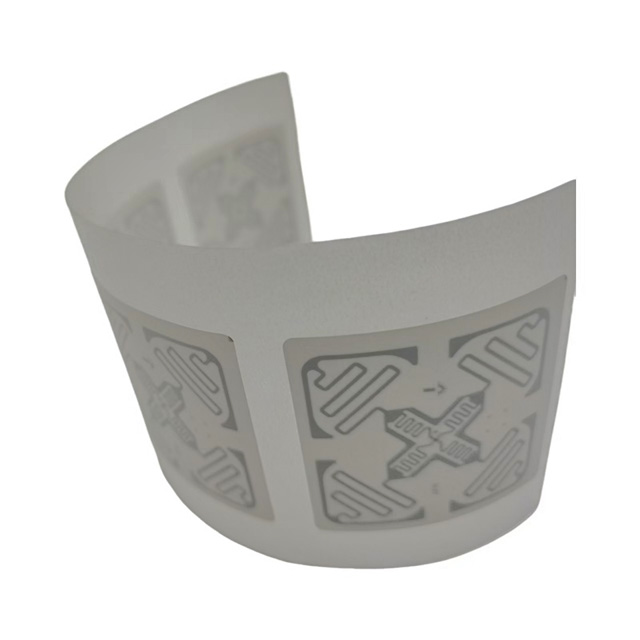
An RFID library label is a thin RFID transponder designed for attachment to books, documents, media, or other library assets.
It normally contains:
RFID chip
Antenna
Substrate
Adhesive layer
Printable or protective surface
Once encoded, the tag can be associated with the library's catalog or circulation database.
The basic process is straightforward.
An RFID reader emits a radio signal through its antenna. When a compatible library tag enters the reading field, the tag responds with its stored identifier.
The library management system then connects that identifier with the corresponding catalog record.
This creates a bridge between the physical book and the library's digital database.
RFID can support self-service circulation stations.
Users place compatible tagged books within the designated reading area, allowing the system to identify items without manually locating each barcode.
Traditional inventory often requires staff to handle books individually.
With handheld RFID readers, staff can move along shelves while the system detects nearby tagged books.
RFID inventory tools can help librarians identify items that may be shelved in the wrong location.
RFID can also be integrated into automated return and sorting equipment.
Returned items are identified and routed according to configured circulation rules.
Depending on the library system and tag configuration, RFID can form part of an electronic article surveillance or access management workflow.
| Feature | RFID Library Label | Barcode |
|---|---|---|
| Direct line of sight | Not required | Required |
| Multiple item detection | Possible | Usually individual |
| Self-service circulation | Well suited | Possible |
| Inventory speed | Faster potential workflow | More manual |
| Initial infrastructure | Higher | Lower |
| Reader requirement | RFID reader | Optical scanner |
Importantly, RFID does not necessarily mean that libraries must immediately eliminate barcodes.
Many institutions operate both technologies during migration.
Frequency is one of the most important decisions in an RFID project.
HF RFID operates at 13.56 MHz and is widely associated with library and smart-card applications.
Its relatively controlled reading range can be advantageous where precise item interaction is required.
UHF operates at higher frequencies and can provide longer reading distances and fast multi-tag identification.
It may be considered for applications requiring broader detection zones or specialized asset-management workflows.
The appropriate technology depends on the existing library infrastructure and intended workflow.
The tag must fit appropriately inside the book or other asset without interfering with normal use.
Library materials may remain in circulation for years.
The adhesive therefore needs to remain stable throughout the expected service life.
The required chip depends on:
System architecture
Data structure
Security requirements
Reader compatibility
Encoding requirements
Never choose tags independently from the reader infrastructure.
The complete system should be tested together.
Libraries or RFID suppliers may print identifiers and encode tag data before deployment.
For larger projects, pre-encoding can simplify implementation.
A library should first map its existing workflow.
Identify where books are:
Cataloged
Checked out
Returned
Sorted
Shelved
Inventoried
This reveals where RFID can provide meaningful automation.
A pilot installation can then test tags, readers, software, and staff procedures before system-wide rollout.
One common mistake is treating RFID labels as standalone products.
The tag is only one component of the system.
Libraries also need to consider:
Readers
Antennas
Self-service stations
Software
Existing library management systems
Encoding workflows
Security requirements
Another mistake is deploying thousands of tags without conducting realistic testing first.
Provide potential suppliers with clear information about:
Required frequency
Existing readers
Library management platform
Tag dimensions
Chip requirements
Memory requirements
Printing requirements
Encoding requirements
Annual volume
For customized projects, request samples for compatibility testing before mass production.
RFID library labels can help libraries modernize the connection between physical collections and digital management systems.
Their main value comes from reducing repetitive identification tasks and enabling more automated circulation and inventory workflows.
Successful deployment, however, requires coordination between tags, readers, software, staff processes, and existing library infrastructure.
Evaluate the entire system rather than choosing a library RFID label based on price or reading distance alone.
It is a thin RFID transponder attached to a library book or other asset, allowing compatible readers to identify the item electronically.
RFID can perform many identification functions traditionally handled by barcodes, but some libraries retain both systems for compatibility or migration purposes.
Placement depends on tag design and library procedures. Labels are commonly attached inside the book in a consistent location.
Yes. Compatible handheld RFID readers can make it easier to identify tagged books while staff move along shelves.
Yes. RFID tags must be used with readers and antennas that support the appropriate frequency, protocol, and system configuration.


