

Views: 0 Author: Site Editor Publish Time: 2026-09-30 Origin: Site
Industrial laundries, hotels, hospitals, and uniform rental companies process thousands of textile items every day. When these items are tracked manually, businesses can face missing linen, inaccurate inventory records, sorting errors, and unnecessary replacement costs.
RFID laundry tags provide a practical way to identify and track individual textile items throughout repeated washing, drying, ironing, distribution, and collection cycles.
Unlike conventional labels or barcodes, RFID tags do not require direct line-of-sight scanning. Multiple tagged items can be identified automatically, helping laundry operators improve inventory visibility and streamline textile management.
This guide explains how RFID laundry tags work, where they are commonly used, what specifications matter, and how to choose the right tag for an industrial laundry application.
Automated Textile Identification: RFID laundry tags give individual garments, towels, sheets, and uniforms a unique digital identity.
Faster Inventory Counting: Multiple RFID-tagged textiles can be scanned without manually locating individual labels.
Designed for Harsh Environments: Industrial laundry tags are engineered to withstand repeated washing, drying, chemicals, pressure, and high temperatures.
Better Inventory Visibility: RFID systems help businesses understand textile circulation, loss rates, wash cycles, and stock levels.
Tag Selection Matters: Frequency, installation method, material, memory, reading distance, and environmental resistance should match the actual application.
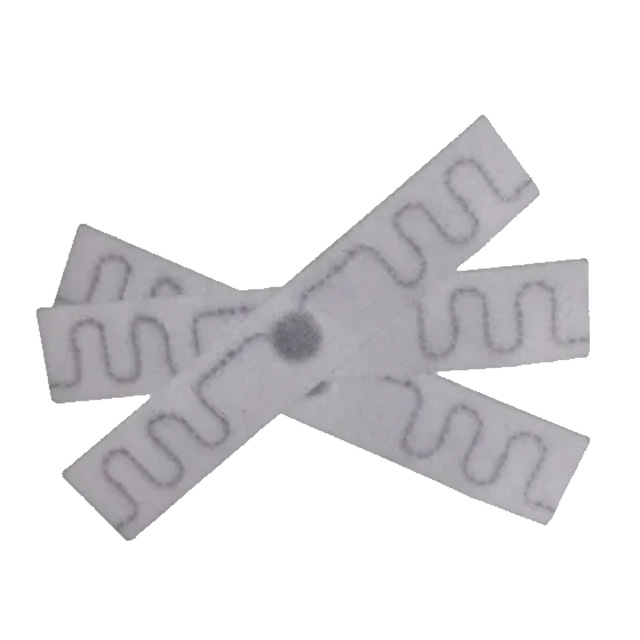
An RFID laundry tag is a small identification device designed to be permanently or semi-permanently attached to textiles.
The tag typically contains an RFID chip and antenna protected by a durable housing or textile-compatible material. Each tag contains a unique identifier that can be associated with information in a laundry management system.
For example, a hotel towel may be associated with:
Item ID
Hotel or department
Textile type
Purchase date
Number of wash cycles
Current status
Previous processing records
Instead of identifying the towel visually, staff can scan its RFID tag and retrieve the associated information digitally.
A typical RFID laundry tracking system consists of three major components:
Each textile item receives an RFID tag containing a unique identification number.
Depending on the application, tags may be sewn into hems, inserted into textile pockets, heat-sealed onto garments, or otherwise integrated into the product.
RFID readers transmit radio signals through antennas.
When compatible tags enter the reading area, they respond with their stored identification information.
Readers may be installed at:
Laundry receiving points
Sorting stations
Washing areas
Distribution centers
Linen rooms
Warehouse entrances
Return points
The RFID hardware identifies the item, while software converts those reads into useful inventory information.
A management platform can associate tag IDs with specific garments and record their movement through different processing stages.
One of the main benefits of RFID is the ability to track textiles throughout their operational lifecycle.
Each textile item receives a unique RFID laundry tag.
The tag ID is registered in the database and associated with information such as product type, customer, department, or batch.
Used textiles are collected from hotels, hospitals, factories, or other facilities.
RFID readers can identify incoming items and record quantities automatically.
The system can help separate textiles according to customer, garment type, washing requirement, or destination.
This reduces dependence on manual sorting.
Tags remain attached while textiles pass through washing, extraction, drying, ironing, and finishing processes.
Industrial RFID laundry tags therefore need to tolerate demanding processing conditions.
After processing, RFID scanning verifies outgoing quantities and destinations.
When textiles return, operators can compare expected inventory with actual returned quantities and investigate missing items.
Hotels manage large quantities of:
Bed sheets
Pillowcases
Towels
Bathrobes
Table linen
RFID can help monitor textile circulation between guestrooms, linen rooms, external laundries, and storage facilities.
Healthcare organizations may use RFID for uniforms, bedding, towels, patient garments, and other reusable textiles.
Accurate identification is particularly valuable when different departments or facilities share laundry operations.
Uniform rental companies need to ensure the correct garments return to the correct customer or employee.
RFID provides each garment with an individual identity throughout repeated service cycles.
Large laundry providers often process textiles belonging to multiple customers.
RFID helps distinguish customer inventory and automate receiving and dispatch verification.
| Feature | RFID Laundry Tags | Barcode Labels |
|---|---|---|
| Line of sight | Not required | Required |
| Multiple-item reading | Yes | Usually one at a time |
| Automated identification | High | Limited |
| Industrial laundry suitability | Designed for repeated processing | Depends on label |
| Bulk inventory counting | Efficient | More labor intensive |
| Individual item tracking | Yes | Yes |
Barcodes can still be suitable for some operations, but RFID becomes particularly valuable when businesses process large quantities of reusable textiles.
UHF RFID is widely used for bulk textile identification because multiple tags can be read efficiently at practical distances.
Compatibility between tags, readers, antennas, and regional frequency requirements should always be confirmed before deployment.
Laundry tags may experience high temperatures during washing, drying, ironing, or finishing.
Always evaluate the tag according to the maximum temperatures in your actual process.
Commercial laundry environments can expose tags to detergents, bleaching agents, disinfectants, and other chemicals.
Tags may experience repeated:
Bending
Compression
Centrifugal force
Washing
Drying
A tag designed for ordinary asset tracking may not be suitable for industrial laundry use.
Common options include:
Sewing
Heat sealing
Pocket insertion
The appropriate method depends on textile type, workflow, equipment, and required durability.
A frequent mistake is choosing tags based only on reading distance.
Longer reading distance is not always better. Excessive range may cause readers to detect textiles outside the intended processing zone.
Another mistake is testing tags individually but not in bulk. Textile stacks, moisture, equipment, antenna placement, and surrounding materials can influence real-world performance.
For this reason, pilot testing should reproduce the actual laundry workflow as closely as possible.
Before placing a bulk order, discuss the following with your supplier:
RFID frequency
Chip options
Memory requirements
Tag dimensions
Installation method
Washing conditions
Maximum temperature
Chemical exposure
Required reading distance
Reader compatibility
Custom encoding
Order quantity
Requesting samples before mass deployment allows you to test the tags in your own laundry environment.
RFID laundry tags transform reusable textiles from difficult-to-monitor inventory into individually identifiable assets.
By integrating RFID identification with readers and laundry management software, hotels, hospitals, uniform providers, and commercial laundries can improve inventory visibility and reduce manual counting.
However, successful implementation depends on more than simply attaching RFID tags to textiles. Tag durability, frequency, reader placement, installation method, and software integration all need to match the real operating environment.
For large projects, begin with a representative pilot batch before moving to full deployment.
An RFID laundry tag is a durable RFID device attached to a textile item so that the item can be electronically identified and tracked throughout its service and laundry lifecycle.
Tags specifically designed for industrial laundry applications are manufactured to withstand repeated washing and processing. Actual resistance varies by product, so temperature, chemicals, pressure, and washing conditions should be confirmed with the supplier.
Tags are commonly sewn into textile seams or hems, inserted into dedicated pockets, or attached using compatible heat-sealing methods.
Compatible UHF RFID systems can identify multiple tags in a reading zone, making them useful for bulk textile inventory applications.
Common applications include hotels, hospitals, commercial laundries, uniform rental companies, factories, spas, and other organizations managing large quantities of reusable textiles.


