

Views: 0 Author: Site Editor Publish Time: 2026-11-04 Origin: Site
Custom PVC 3-up Key Tag Combo Cards for Loyalty & Access Programs
A customer reaches the till, pats down their pockets, and admits they left their loyalty card at home again. If you run a retail loyalty scheme, a gym, a car wash or a members-only venue, that scene is familiar — and it costs you a lost scan, a lost reward, and a lost data point. A custom printed PVC 3-up key tag combo card is one of the simplest fixes: a single credit-card-sized sheet carrying three small, pre-scored tags that snap apart and go straight onto a keyring.
A 3-up key tag combo card is a laminated PVC sheet printed with your branding and die-cut into three detachable mini tags along breakaway score lines. Each tag carries its own identification — a barcode, QR code, sequential number or membership ID — and usually a punched hole for a keyring or lanyard. The tags stay attached as one flat sheet through printing, encoding, quality checks and shipping, then separate by hand at the point of issue.
A 3-up key tag combo card is a laminated PVC sheet printed with your branding and die-cut into three detachable mini tags along breakaway score lines. Each tag carries its own 1identification — a barcode, QR code, sequential number or membership ID — and usually a punched hole for a keyring or lanyard. The tags stay attached as one flat sheet through printing, encoding, quality checks and shipping, then separate by hand at the point of issue.
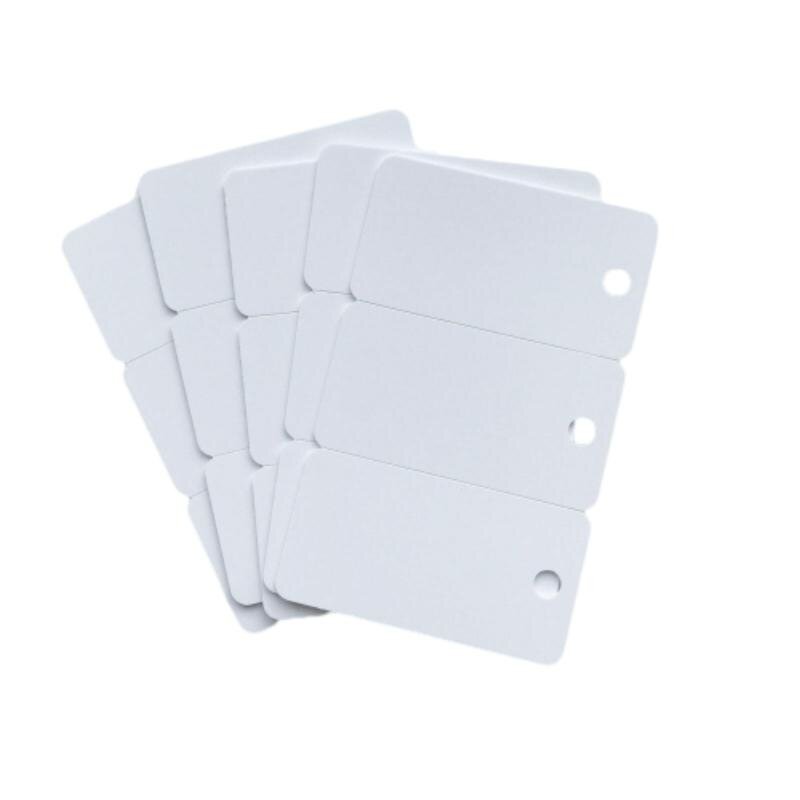
The term is used loosely in the industry, and two different layouts are sold under the same name. Confirming which one your supplier means is the single most common way to avoid an expensive order error:
| Layout | What you receive | Typical sheet size | Best for |
|---|---|---|---|
| Three equal tags on a CR80 sheet | Three mini tags, each ~28.5 × 54 mm; no wallet card | 85.5 × 54 mm (CR80) | Programs where the tag is the credential; maximum tags per print run |
| Wallet card + three breakaway tags | One full-size card to keep in a wallet, plus three snap-off key tags on an extended sheet | 114 × 54 mm or 142.5 × 54 mm | Membership packs, gift sets, and programs that also print a formal membership card |
You may also see these referred to as triple combo cards, 3-up breakaway cards, key tag combination cards, snap-off key tag cards, or simply 3-up keytags. In North American catalogues, the common phrasing is "plastic card & key tag combo."
"Up" is printer shorthand for how many key tags are attached to one sheet. It is not a quality grade or a version number.
| ormat | Tags per sheet | Common use |
|---|---|---|
| 1-up | 1 key tag + wallet card | Single-member programs, hotel and resort key cards |
| 2-up | 2 key tags + wallet card | Couples, two-car households |
| 3-up | 3 key tags (with or without wallet card) | Families, multi-driver households, spare + replacement tags |
A 3-up card is the practical sweet spot: it gives one account enough tags for a household, a spare in the glove box, and a replacement without reprinting, while still fitting standard CR80 production and encoding equipment.
Standard cards are laminated PVC at 0.76 mm (30 mil) — the same thickness as a bank card. Lamination fuses the printed layers, which is why the tags survive keyring abrasion, pocket lint, rain, sunscreen and a trip through the car wash. They are waterproof, tear-resistant, and rigid enough to keep a barcode flat for scanning. Paper punch cards and printed stickers fail on all three counts.
The credential lives on the keys, not in a drawer. Customers rarely leave home without their keys. A tag on a keyring is seen several times a day — a small, repeated brand impression that a wallet card or an app icon cannot match. That visibility is the main reason physical key tags still outsell purely digital loyalty in many independent retail and fitness businesses.
One membership covers a whole household. A gym family, two drivers sharing a car wash plan, or parents and a caregiver all need to be recognised under one account. Three tags let you issue all of them from one print run, either with the same member ID or with three unique IDs linked to one account in your POS.
It works with the systems you already have. Barcodes, QR codes, and magnetic stripes are read by most existing point-of-sale and access control systems. There's no app to download, no phone number to capture, and no onboarding step at the counter — which also means less personal data to store and fewer privacy obligations.
4.The cost per credential is low. Printing, encoding and finishing three tags on one sheet costs marginally more than one tag. Compared with issuing three separate plastic cards, a combo card cuts material, packaging and handling costs substantially.
5.Spares reduce reissue admin. Lost tags are inevitable. Handing a member a spare at sign-up costs cents; reprinting, re-encoding and mailing a replacement costs far more.
6.They are inclusive. Key tags work for children, older customers, and anyone who does not want a loyalty app or does not carry a smartphone.
| Industry | How the tags are used | Typical data on the tag |
|---|---|---|
| Retail & supermarket loyalty | Scan at checkout to earn points or redeem rewards | Code 128 / EAN-13 barcode, member number |
| Gyms, fitness studios, 24-hour clubs | Fast check-in and after-hours door access | Barcode or 13.56 MHz RFID/NFC, member ID |
| Car washes & auto service | Unlimited-wash plans, one tag per vehicle | Barcode or RFID reader compatible |
| Salons, spas, pet grooming | Visit tracking, VIP tiers, referral tracking | QR code or sequential membership number |
| Cafés, restaurants, bars | VIP discounts, "buy 9 get 1" style programs | Barcode, writable stamp/signature strip |
| Hotels, resorts, campgrounds | Room or site identification, pool/gate access | Magstripe, RFID, or QR code |
| Libraries, clubs, co-working spaces | Membership ID and attendance logging | Barcode, name, membership number |
| Schools & childcare | Authorised-pickup and check-in identification | Photo, name, unique ID, QR code |
| Item | Standard option | Custom options |
|---|---|---|
| Sheet size | CR80, 85.5 × 54 mm | 114 × 54 mm, 142.5 × 54 mm (card + 3 tags), custom die-lines |
| Individual tag size | ~28.5 × 54 mm (3 equal tags) | Custom shapes, rounded corners, die-cut outlines |
| Thickness | 0.76 mm / 30 mil | 0.5 mm, 0.84 mm, 1.0 mm for extra rigidity |
| Material | White PVC | Recycled PVC (RPVC), PETG, PVC-free / biodegradable stock, Teslin |
| Printing | CMYK offset, double-sided full colour | Digital for short runs, silk screen, white ink, Pantone spot colour |
| Surface finish | Gloss laminate | Matte, frosted |
| Special effects | — | Spot UV, hot foil stamping, embossing, scratch-off panel, holographic overlay |
| Separation & attachment | Pre-scored breakaway lines | 3–5 mm punched hole, slot for lanyard, keyring supplied |
| Variable data | Sequential numbering | Unique barcode/QR per tag, names, member IDs, PINs, photo personalisation |
| Writable areas | — | Signature panel, writable strip for stamping visits |
| Encoding | Barcode / QR | Magstripe (LoCo / HiCo), 13.56 MHz RFID/NFC, 125 kHz proximity |
| Order terms | MOQ 100 sets | Samples available, typical production 7–12 working days after proof approval |
Barcode — the default for loyalty. Cheap, universally supported, and easy to reissue. Code 39 and Code 128 are the safest choices for membership numbers; EAN-13 is used when your POS expects retail-style numbers. Before you order, ask your POS provider which symbology and character length it accepts, then send that specification to your printer. Mismatched symbology is the number one reason a beautiful batch of cards will not scan.
QR code — best when a phone is the reader. QR codes can hold a member ID, a loyalty-page URL, or a vCard, and can be scanned by any smartphone camera. They are ideal for programs that do not have dedicated scanners at the counter.
Magnetic stripe — for legacy systems. Choose HiCo (high coercivity) for cards that live on a keyring near magnets and phones; LoCo is cheaper but more easily erased. Note that a stripe usually runs along the full sheet, so confirm which tag retains it after the card is snapped apart.
RFID / NFC — for access control and touch-free check-in. 13.56 MHz chips (MIFARE Classic, MIFARE Ultralight, NTAG213/215/216) suit door access and fast gym check-in; 125 kHz proximity chips suit older readers. RFID adds unit cost and requires compatible readers plus correct chip encoding.
Finishes and special effects
Gloss reads as premium and photographs well for product listings; matte resists fingerprints and hides keyring scratches; frosted gives a modern, semi-transparent look. Spot UV over a logo, metallic foil, or an embossed membership number add perceived value for VIP tiers without changing the underlying card. Keep these effects away from the barcode area and the punched hole.
Final thoughts
A 3-up key tag combo card is not a complicated product, which is exactly why it works: one printed sheet, three credentials, no app, no onboarding, and a brand that travels on the customer's keys
FAQ
1.What is a 3-up key tag combo card?
A single printed PVC sheet carrying three detachable mini key tags joined by pre-scored breakaway lines. Some versions are three equal tags on a credit-card-sized sheet; others include one full wallet card plus three tags on an extended sheet. Each tag can carry its own barcode, QR code or membership number.
2.What size is a 3-up key tag card?
The standard sheet is CR80, 85.5 × 54 × 0.76 mm, divided into three tags of roughly 28.5 × 54 mm. Card-plus-tags versions are usually 114 × 54 mm or 142.5 × 54 mm. Always confirm the die-line with your supplier before designing artwork.
3.Do the tags arrive separated, and do I need a tool to break them apart?
They arrive as one flat sheet, which protects the print and makes encoding and packing easier. The score lines let you snap the tags apart by hand — no scissors or tools needed. A pre-punched hole on each tag takes a standard split keyring.
4.
What artwork files do you need?
Vector artwork in AI, PDF, EPS or CDR, with fonts outlined, colours in CMYK, raster images at 300 dpi, and 3 mm bleed. Request the factory's die-line template first, and send variable data separately as CSV or XLSX.


